How Acu-Res® works
Wind sensors powered by Acu-Res® Technology
Invented by our Executive Chairman, Dr Savvas Kapartis, Acu-Res® is a solid-state (no moving parts) technology for measuring wind speed and direction.
Acu-Res® uses an acoustic (ultrasonic) wave which is resonated inside a small cavity. A strong resonating sound wave in a small space gives a signal to noise ratio more than 40dB stronger than other ultrasonic technologies.
Acu-Res® is unique to FT Technologies and is what gives our sensors a more robust and reliable measurement solution compared to alternative products on the market.
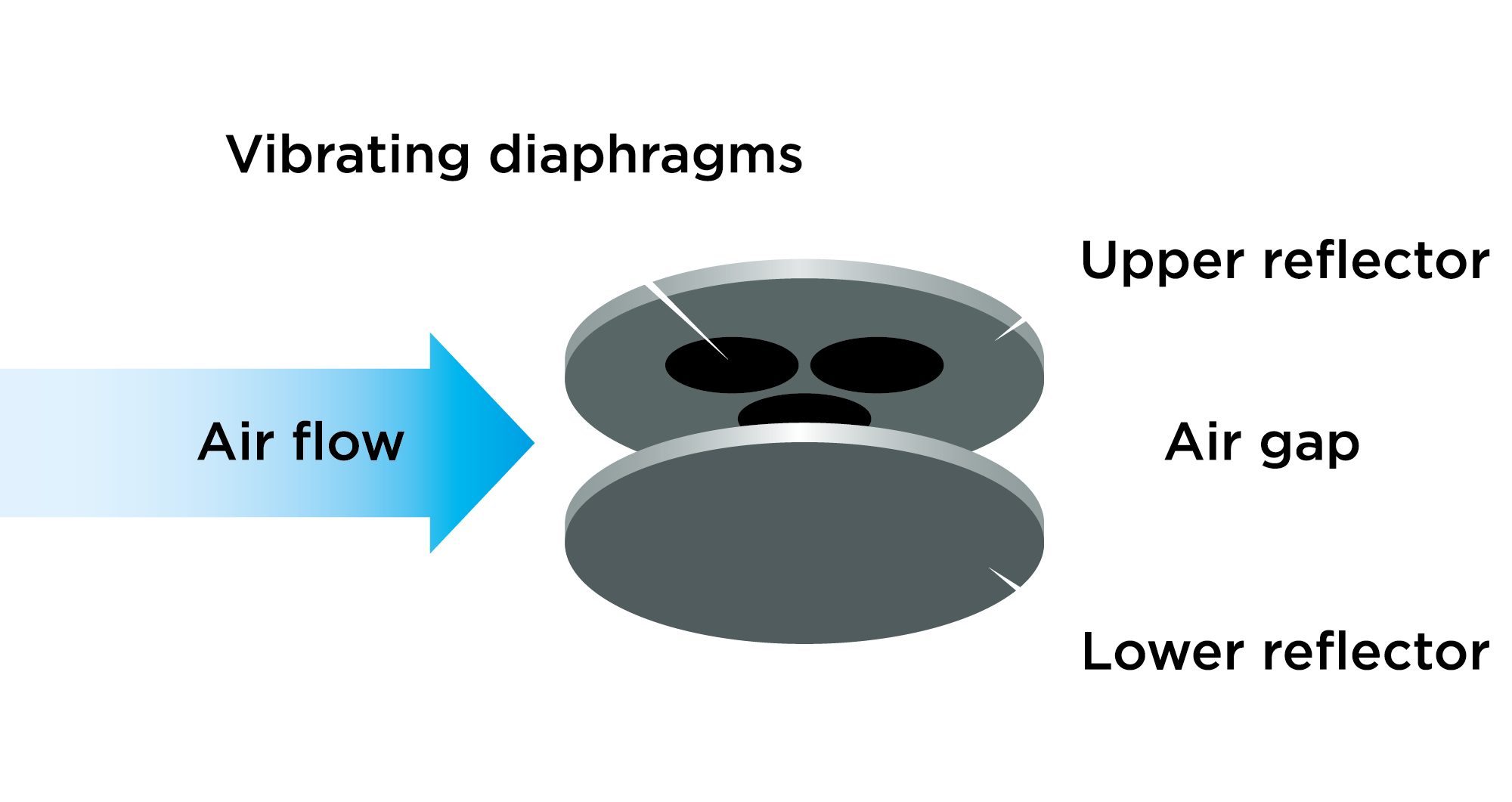 In its most basic form, the device consists of a pair of small parallel plates, termed the upper and lower reflectors. In the horizontal plane, the structure is unbounded and air flows freely between the plates. In the vertical direction it is bounded by the reflectors and the average air velocity in that direction is negligible. Acoustic (ultrasonic) waves are generated and received by means of three vibrating diaphragms coupled to an equal number of piezo-electric elements. The diaphragms are arranged in a triangular formation as shown in the diagram.
One diaphragm is electrically excited at any one time. Ultrasound emanates from its surface and travels outwards until it hits the lower reflector where it undergoes a near total reflection. The resulting wavefront travels upwards, hits the upper reflector and is reflected again. Ultrasound continues to bounce between the pair of reflectors until it is sufficiently attenuated by the loss of energy in the surrounding air and the succession of imperfect reflections. In practice the process involves about 200 reflections.
Over a narrow frequency band the individual reflections combine in phase to produce a dramatic increase in signal strength. The net wave distribution is complex but it can be thought of as a vertical quasi-standing wave, which in the horizontal plane behaves like a two-dimensional radial travelling wave. This dual character of the acoustic field is exploited in the following manner:
Airflow Measurement Is Based On The Travelling Wave Behaviour
The net phase between any diaphragm pair is indicative of the airflow along the axis of the pair. With all three diaphragm pairs measured the component vectors of the airflow along the sides of the triangle (formed by the diaphragms) are determined. These vectors are combined to give the overall speed and direction.
Automatic Compensation Is Based On The Standing Wave Behaviour
The speed of sound in air varies as a function of temperature, humidity and to a lesser extent, pressure. Acu-Res® provides automatic compensation for this without the need for additional sensors. In operation the electronics adjust the frequency to maximise the response and maintain resonance. Under these conditions measurements are made independent of the speed of sound.
Moreover, operation at resonance drastically reduces the undesirable influence of acoustic reflections from nearby objects, aerodynamic effects, e.g. turbulence, and flow non-uniformity. The close proximity of the vibrating diaphragms permits operation at high air speed and the monolithic construction results in improved accuracy. The relationship between air speed and measured phase is linear. Furthermore the selective response at resonance provides a “front-end tuned filter” dramatically improving the signal to noise ratio. Signal power is kept extremely low, (typically tenths of microwatts) and the operating signature is negligible. Acu-Res has many advantages over alternative technologies and some of the more important are listed below.
- Wide and scaleable dynamic range
- Linear response of phase vs. air speed
- Precise speed and direction indication
- Wind direction accuracy independent of speed
- Inherently compensated against fluctuations in temperature pressure and humidity
- Rugged, fully sealed construction for all weather operation and high availability
- Reliable solid state (no moving parts) construction
- Small, lightweight and easy to heat
- Low power consumption

Every FT Technologies wind sensor has advanced Acu-Res® software built in. This does all the complex calculations required to derive wind speed and wind direction as well as:
Acu-Res® software has been developed specifically for the air flow industry and optimised to deliver best performance for wind measurement applications.
The Acu-Res® Environmental Protection System (EPS) has been designed to allow the sensor to work reliably under the most extreme conditions.
Changes in air density and particulates in the air can affect the accuracy of cup anemometers. Ultrasonic time of flight instruments can have a lower accuracy due to precipitation with rain and dust reflecting or distorting the effective path of the sonic pulses.
The speed of sound in air varies as a function of temperature and to a lesser extent, humidity and pressure. Acu-Res® powered sensors adapt their transmission frequency to maintain resonance, thus automatically compensating for any environmental change. The quality of an air flow measurement can be assured as the ability of the sensor to maintain resonance is also monitored and reported by the Acu-Res® software.
The EPS helps to guarantee high data availability in all weather conditions and has been optimised to minimise the effects of:
- Lightning and EMC
- Dust and sand
- Solar radiation
- Heavy rain
- Salt water
- Snow, freezing rain and ice
- Hail
- Physical impact
- Vibration
- Corrosion
- Weathering and ageing
The EPS ensures high levels of availability by incorporating:
- A hard anodised alloy body which is strong, corrosion resistant and transmits heat easily and evenly
- A sealing system in the body and around the connector which keeps out sand, dust and water
- Surge protection electronics to increase the sensor’s immunity to large voltage and current transients induced by lightning strikes
- Three heaters which maintain the sensor at a constant temperature and stop it from icing up
- Super hydrophobic coating which helps keep the sensor clean and dry
- Highly Accelerated Life Cycle testing which qualifies the sensors to withstand extremes of temperature and vibration
The combined benefits of Acu-Res® Technology are why we believe the FT7 Series to be the world’s toughest wind sensors.
European Patent No: EP 0 801 311. USA Patent No: 5,877,416.